By the end of this chapter, you should be able to:
Differentiate between the chain of infection components and identify the weakest link for breaking the cycle.
Distinguish between Standard Precautions and Transmission-Based Precautions, and apply them to specific patient scenarios.
Correctly perform and sequence hand hygiene, donning and doffing of PPE, and disposal of sharps.
Identify the three classes of bloodborne pathogens and the post-exposure protocol steps.
Apply OSHA Bloodborne Pathogens Standard requirements, including the Exposure Control Plan and warning labels.
Recognize the roles of sanitization, disinfection, and sterilization, and select the appropriate level for common medical instruments.
Explain the medical assistant's role in CLIA waived testing, including quality control and documentation.
Identify safety risks in the ambulatory setting, including fire (RACE/PASS), electrical, and ergonomic hazards.
1.1 The Chain of Infection and Modes of Transmission
The chain of infection is a model used to explain how an infectious agent spreads from a reservoir to a susceptible host. The chain has six links:
15.Infectious agent – the pathogen (bacteria, virus, fungus, parasite).
16.Reservoir – where the pathogen lives and multiplies (humans, animals, fomites, water).
17.Portal of exit – how the pathogen leaves the reservoir (respiratory droplets, blood, feces, skin).
18.Mode of transmission – how the pathogen travels (contact, droplet, airborne, vector, vehicle).
19.Portal of entry – how the pathogen enters the new host (mucous membranes, broken skin, inhalation, ingestion).
20.Susceptible host – a person at risk (immunocompromised, unvaccinated, elderly, infants).
Breaking any link stops the infection. In the medical office, the most practical links to break are the mode of transmission (via hand hygiene and PPE) and the portal of entry (via aseptic technique and proper wound care).
Modes of transmission you must know for the exam:
Contact – direct (skin-to-skin) or indirect (via a contaminated object, e.g., stethoscope, doorknob). MRSA and scabies are contact-spread.
Droplet – large respiratory particles (>5 microns) travel ≤ 6 feet. Examples: influenza, pertussis, meningococcal meningitis. Requires a surgical mask.
Airborne – small particles (<5 microns) that remain suspended in air for long periods. Examples: tuberculosis, measles, varicella (chickenpox). Requires an N95 respirator (or higher) and a negative-pressure room.
Vehicle – contaminated food, water, or blood (e.g., hepatitis A via food).
Vector – living organism carries the pathogen (e.g., tick → Lyme disease, mosquito → West Nile).
1.2 Standard Precautions vs. Transmission-Based Precautions
Standard Precautions (from the CDC) are the minimum infection prevention practices applied to all patients, regardless of suspected or confirmed infection status. They assume that every body fluid, blood, secretion, and non-intact skin is potentially infectious. Key components:
Hand hygiene (before and after patient contact, after glove removal, after touching blood/body fluids).
Use of PPE (gloves, gown, mask, eye protection) based on anticipated exposure.
Safe injection practices (never recap needles, use a new needle/syringe for each patient).
Proper handling of contaminated equipment and linens.
Transmission-Based Precautions are additional precautions used for patients known or suspected to be infected with highly transmissible pathogens. They are used in addition to Standard Precautions, never instead of them.
Category
PPE Required
Common Diseases
**Contact**
Gloves, gown (change after patient)
MRSA, C. diff, scabies, wound infections
**Droplet**
Surgical mask (within 6 feet)
Influenza, pertussis, mumps, rubella
**Airborne**
N95 respirator, negative-pressure room
TB, measles, varicella
Exam trap: Students often confuse droplet and airborne. Remember: Droplet = large particles, short distance, surgical mask. Airborne = small particles, long distance, N95.
1.3 Hand Hygiene and PPE
Hand hygiene is the single most effective way to prevent infection transmission. The two acceptable methods are:
Handwashing with soap and water – required when hands are visibly dirty, after using the restroom, and when caring for patients with C. difficile (alcohol-based rubs do NOT kill C. diff spores).
Alcohol-based hand rub (60–95% alcohol) – preferred method when hands are not visibly soiled.
When to perform hand hygiene:
Before and after patient contact.
Before donning gloves and immediately after removing them.
After contact with blood, body fluids, or contaminated surfaces.
Between tasks on the same patient (e.g., moving from a contaminated to a clean site).
After removing PPE.
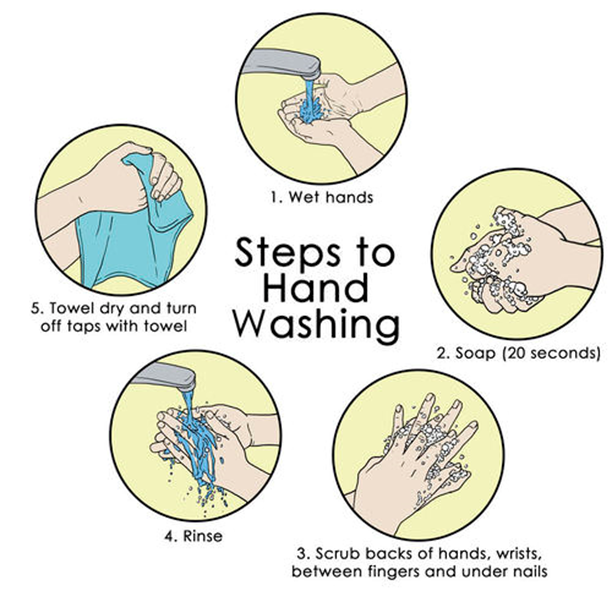
Proper handwashing technique: Wet hands, apply soap, scrub all surfaces (palms, backs, between fingers, under nails) for at least 20 seconds, rinse, dry with a clean towel, and use the towel to turn off the faucet.
PPE donning order (putting on):
52.Gown (tie at neck and waist)
53.Mask/respirator (secure bands, mold nose piece)
54.Eye protection (goggles or face shield)
55.Gloves (pull over gown cuffs)
PPE doffing order (removing) – the "dirty" sequence:
57.Gloves – grasp outside of one glove at the wrist, peel off, hold in gloved hand; slide ungloved fingers under the other glove at the wrist, peel off, and discard. Gloves are the most contaminated.
58.Gown – untie, pull from shoulders, turning it inside out, and roll into a ball.
59.Eye protection – remove by touching only the earpieces or headband (front is contaminated).
60.Mask/respirator – remove by touching only the ties/bands; discard. (Mask is removed last because it protects your airway.)
Critical rule: Never touch the front of the mask or the outside of the gloves with bare skin. Perform hand hygiene immediately after removing all PPE.
1.4 OSHA Bloodborne Pathogens Standard
The OSHA Bloodborne Pathogens Standard (29 CFR 1910.1030) protects healthcare workers from occupational exposure to blood and other potentially infectious materials (OPIM). OPIM includes semen, vaginal secretions, cerebrospinal fluid, synovial fluid, pleural fluid, pericardial fluid, peritoneal fluid, amniotic fluid, and any body fluid visibly contaminated with blood.
Employer requirements (that you must know for the exam):
Exposure Control Plan – a written document identifying at-risk employees and procedures for reducing exposure.
Engineering controls – devices that isolate or remove the hazard (e.g., sharps containers, self-sheathing needles, needleless systems).
Work practice controls – behaviors that reduce exposure (e.g., no recapping, no bending needles, washing hands after glove removal).
PPE – provided at no cost to the employee.
Hepatitis B vaccination – offered free of charge within 10 days of hire.
Warning labels – red or orange-red labels with the biohazard symbol on containers of regulated waste, refrigerators/freezers storing blood, and contaminated equipment.
Training – provided at hire and annually.
Post-exposure evaluation – confidential medical evaluation and follow-up after a reported exposure.
The "Universal Precautions" concept (treating all blood/body fluids as infectious) is incorporated into Standard Precautions. The term "Universal Precautions" is still used by OSHA, but the CDC now uses Standard Precautions.
Regulated waste includes: liquid or semi-liquid blood, items contaminated with blood that would release it if compressed, contaminated sharps, and pathological/microbiological wastes. Sharps must be placed in a puncture-resistant, leak-proof, labeled container immediately after use.
1.5 Bloodborne Pathogens: HIV, HBV, HCV
The three primary bloodborne pathogens are:
Hepatitis B (HBV) – most infectious; can survive on surfaces for up to 7 days. Vaccine-preventable. Symptoms: jaundice, fatigue, abdominal pain. Risk of chronic infection is highest in infants.
Hepatitis C (HCV) – chronic infection in most cases; no vaccine. Leading cause of liver transplant in the US.
HIV – attacks CD4+ T cells; no vaccine. Post-exposure prophylaxis (PEP) must be started within 72 hours (ideally within 2 hours) of exposure.
Post-exposure management (after a needlestick or splash):
83.Immediately wash the exposed area with soap and water (for skin) or flush with water or saline (for mucous membranes/eyes). Do NOT squeeze the wound.
84.Report the exposure to your supervisor immediately.
85.Seek confidential medical evaluation (testing of source patient and exposed worker).
86.Document the incident per the Exposure Control Plan.
Exam trap: Students often think you should "milk" or squeeze a needlestick wound to express blood. This is wrong – it increases tissue damage and absorption. Just wash gently.
1.6 Sanitization, Disinfection, and Sterilization
The Spaulding Classification system categorizes medical instruments by the risk of infection they pose:
Category
Definition
Examples
Required Level
**Critical**
Enters sterile tissue or vascular system
Surgical instruments, needles, catheters
**Sterilization** (destroys all microorganisms, including spores)
**Semicritical**
Contacts mucous membranes or non-intact skin
Endoscopes, laryngoscope blades, vaginal specula
**High-level disinfection** (destroys all microorganisms except some spores)
**Noncritical**
Contacts intact skin only
Stethoscopes, blood pressure cuffs, exam tables
**Low-level disinfection** or **sanitization**
Definitions:
Sanitization – reduces the number of microorganisms to a safe level (cleaning with soap and water). Used for noncritical items and before disinfection/sterilization.
Disinfection – destroys most pathogenic organisms but not bacterial spores. Chemical disinfectants (e.g., bleach, glutaraldehyde). Intermediate-level kills TB, HBV, HIV; low-level kills vegetative bacteria and some viruses.
Sterilization – destroys all forms of microbial life, including spores. Methods: autoclave (steam under pressure, most common), dry heat, ethylene oxide gas, chemical sterilants.
Autoclave basics: Temperature ~121°C (250°F) at 15 psi for 15–30 minutes. Use biological indicators (spore tests) at least weekly to verify effectiveness. Chemical indicators (tape) change color but do not prove sterilization.
Cleaning rule: Always clean (sanitize) an item before disinfection or sterilization. Organic material inactivates chemical disinfectants and blocks steam penetration.
1.7 CLIA Waived Testing and Quality Control
CLIA (Clinical Laboratory Improvement Amendments) categorizes tests by complexity. Waived tests are simple, low-risk tests approved by the FDA for use in physician offices. Examples: urine dipstick, rapid strep, glucose monitoring, pregnancy tests, fecal occult blood, INR (CoaguChek).
Medical assistant responsibilities for waived testing:
Follow the manufacturer's instructions exactly (do not improvise).
Perform quality control (QC) – run known positive and negative controls as specified (usually daily or with each new lot).
Check expiration dates on reagents and test kits.
Document all QC results and patient results.
Calibrate instruments per manufacturer schedule.
Report results accurately and promptly.
Common errors: Using expired reagents, not running controls, mislabeling specimens, and failing to document. If a control fails, do not report patient results – troubleshoot and repeat.
1.8 Fire Safety, Electrical Safety, and Ergonomics
Fire safety – RACE:
R – Rescue: remove patients in immediate danger.
A – Alarm: activate the fire alarm and call 911.
C – Contain: close doors and windows to contain the fire.
E – Extinguish: use a fire extinguisher (only if the fire is small and you are trained).
PASS (using a fire extinguisher):
P – Pull the pin.
A – Aim at the base of the fire.
S – Squeeze the handle.
S – Sweep side to side.
Fire extinguisher classes:
Class A – ordinary combustibles (wood, paper) – water/foam.
Class B – flammable liquids (alcohol, grease) – CO2 or dry chemical.
Class C – electrical equipment – CO2 or dry chemical (never water).
Class D – combustible metals (rare in medical offices).
Class K – cooking oils (kitchens).
Electrical safety: Inspect cords for fraying, do not overload outlets, unplug by pulling the plug (not the cord), never use equipment with wet hands, and report any shocks or sparks immediately.
Ergonomics: Position the computer monitor at eye level, keep wrists neutral, use a chair with lumbar support, and take micro-breaks. When lifting, bend at the knees, keep the back straight, and hold the load close to the body. Never twist while lifting.
1.9 The Medical Assistant's Role in Immunizations
The CDC immunization schedule is the authoritative reference for vaccine timing. Medical assistants may administer vaccines (per state law) but must:
Verify the correct vaccine, dose, route, and site (IM for most, SQ for some like varicella).
Check the patient's allergy history (especially to eggs, gelatin, neomycin).
Screen for contraindications (e.g., live vaccines are contraindicated in pregnancy and severely immunocompromised patients).
Document the vaccine name, lot number, date, site, route, and manufacturer.
Provide the VIS (Vaccine Information Statement) to the patient or guardian before administration.
Observe the patient for 15–30 minutes for allergic reactions.
Maintain the cold chain (refrigerate vaccines at 2–8°C; do not freeze).
Common vaccines: MMR (live), varicella (live), influenza (inactivated or live attenuated intranasal), hepatitis B (recombinant), Tdap (tetanus, diphtheria, pertussis).
1.10 Common Exam Traps
142.Confusing droplet vs. airborne precautions. Droplet = surgical mask, 6 feet. Airborne = N95, negative pressure. Students pick "surgical mask for TB" – wrong. TB is airborne.
143.Recapping needles. The correct answer is never recap. Students sometimes choose "recap using one hand" – this is still not recommended and is against OSHA work practice controls.
144.Hand hygiene after glove removal. Students think gloves replace handwashing. They do not. Always wash after removing gloves.
145.Order of PPE doffing. Gloves are removed first, mask last. Students often remove the mask first – this risks contaminating the face.
146.CLIA waived tests. Students assume "waived" means "no quality control needed." Wrong – QC is still required.
147.Sterilization vs. disinfection. Students pick "disinfection" for surgical instruments. Critical items require sterilization.
148.Fire extinguisher class for electrical fires. Students pick "water" – never use water on electrical fires (Class C).
149.Post-exposure action. Students pick "squeeze the wound to express blood" – wrong. Wash gently with soap and water.
150.Hepatitis B vaccine timing. Students think it's given "at hire" – OSHA says within 10 days of hire.
151.C. diff hand hygiene. Students pick alcohol-based rub – wrong. C. diff spores require soap and water.
152.Chain of infection – weakest link. Students often pick "reservoir" – but in the ambulatory setting, the mode of transmission is the most practical to break.
153.Autoclave monitoring. Students pick "chemical indicator tape is sufficient" – biological spore tests are required weekly.
Summary
Infection control is a core competency for the CCMA. Master the chain of infection, Standard vs. Transmission-Based Precautions, PPE sequence, OSHA requirements, and the Spaulding classification. Remember that safety protocols exist to protect you and your patients. On the exam, read each question carefully and apply the most specific guideline. When in doubt, choose the option that is most conservative (more protection, more cleaning, more documentation).